

Tracing Pledge: No More Animation or Video
For the next year, TracingVRL is committing to motionless media for all readers
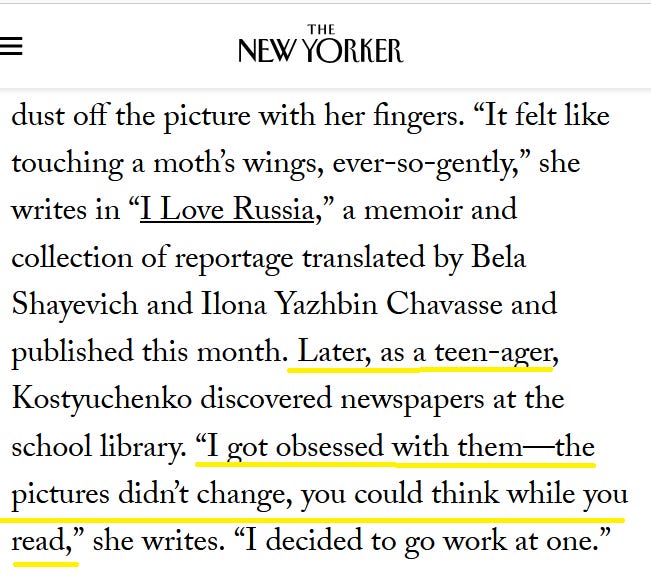
Hello reader, the world is straining my attention of late. Is this happening for you as well? So … much as I love creating effects through animated illustrations, I’m committing to you to provide motionless media for the next 12 months from this outlet.
Any and all video will be in its own file with the word “VIDEO:” prefacing its title.
The New York Times has been turning into a television. I love television, or do in certain settings. True television theater, consumed in a viewing room where we get to stretch our eyes, can be a quality media experience. Be it a WWF match or Masterpiece Theater, that distance is a reminder we’re not thinking the show, we’re watching the show. I glean different points from a video viewed this way.
Our Rectangles are Shrinking
Have you noticed laptops/desktops are disappearing from our world? I have met in the last year two small business owners who pay mortgages — not rent, mortgages — who no longer use laptops. They didn’t replace their computers the last time they broke. These go-getters are on the run, chasing sales leads, working side gigs, using just their phones. One texted me a meditation YouTube video when I asked how she maintains her poise. The video had no title when it landed in my phone. It was just a bearded man talking.
A job-hunting site decomissioned its website, and users now have to squint-and-scroll to line up petsitting gigs through Care.com via smart phone. Maybe mobile apps throw off more behavioral data exhaust Care.com can sell, and that’s why they’re an app-only site now? Who knows.
I’ve been without podcasts for months, because my iPods finally stopped working. I kept a gold iPod for podcasts and a fuscia iPod for music. No more. I can still charge the battery, but the last podcast loaded onto the little gold square of joy is my only content on offer.
The iPhone is a terrible, TERRIBLE podcast lisening device. TERR-I-BLE! If you’re a podcast host and your audience has plummeted since January it’s not your fault!
ITunes is an affordace for curation and discovery when viewed on the desktop. The iPods, which the Apple Store will not support “it’s an obsolete device” had tactile buttons we could use to pause or “next” forward our playlist.
The iPhone requires bringing your glasses onto the treadmill and stairmaster if you want to “next” your playlist or pause to talk to a passerby.
Before, I would load from iTunes: a listen three episodes old from artofmanliness.com, a listen five episodes old from KALW’s Your Call podcast, and the latest episode of the Marc Maron podcast. Now I only listen to Marc Maron because I’m forced to use my smart phone. I keep meaning to listen to What Rough Beast, but the tiny rectangle of the iPhone pushes it out of the display real estate. On the regular.
To be discovered on the iPhone, you have to be discovered on the desktop. And we’re phasing out desktops. Desktops just don’t exhaust behavioral data like phone apps (I suspect,) and companies need to make money by selling behavioral data (I suspect.)
You Know Who Else Went from Desktop Text to Smartphone Video? Myanmar!
I was telling myself “A.J., just adapt to post-literacy.” But post-literacy is a euphamism for illiteracy. Adults who grew up reading are subject to neuroplasticity. You just don’t get the same amount of information from three minutes of video that you do from three minutes of reading.
Yes, text is a pain. When you scroll to read a long-form piece, the title is pushed out of the frame and you forget what it was you were reading.
But I’m trying to practice cultural harm-reduction. Blend in with where the adults who lost their social and reading habits during COVID lockdown now are. So I rolled with it.
Then days ago I saw another interview with Sarah Wynn-Williams, who for some reason is only interviewed on British or Australian news shows. I saw this because I had consciously visited a video site, YouTube.com.
Sarah Wynn-Williams, if you don’t recognize the name, is the woman who worked for years at Facebook and like many other ex-employees from that company, wrote a tell-all memoir. Her memoir has to be the best one yet, it’s called “Careless People” I just checked a copy out from the library, and wow.
At the 30-minute mark in Sarah Wynn-Williams’ interview with The News Agents [Mar 14 VIDEO: HOW Zuckerberg’s Facebook Could’ve Helped China Spy on Millions (The News Agents YouTube Channel) link →], they discuss the country of Burma, now called Myanmar. Years after mobile phones in Myanmar were adapted to offer an “f” button, so users could access the internet, they devolved into a horrific genocide in which tens of thousands of people fled the country and 6,700 people were killed.
The interviewer rightly asks, how could a genocide be attributed to Facebook? Wynn-Williams first points to a written investigative report published by the United Nations “I think there's a lot of documentation in for example in that United Nations report that directly attributes it to Facebook.”
The Burmise, or citizens of Myanmar didn’t have access to the greater internet in 2012 after Facebook landed there. They only had access to social media with all its automated algorithmic amplification of engaging content. And they could only access it through their tiny phones:
Interviewer: You say about Burma, Myanmar, “every turn when Facebook leaders see how FB is flaming tensions and making unstable situation worse, they do nothing. The truth is inescapable. Myamar would have been far better off than if Facebook had never arrived there.” What does far better off mean then?
Wynn-Williams: So I was one of the first Facebook employees um to visit Burma and my and it was it was just a crazy experience because it's one of the few countries where they didn't have desktop. Because the country was so sealed off. They went straight from no internet to mobile. So you could see what it would be like if our only you know in many ways I think our early experience of the internet has saved us. Because this country where everyone went straight to mobile and they had the power to fire off whatever no nothing came down and when I met these people they're like “you know Facebook is the homepage for our country.” And that homepage led to the most horrific horrific genocide.
So I think I think it's one of those things where we as we use it you know either in the UK or or in other places around the we experience one version of these products. But there's a much worse version out there. And without the few, you know, limits that are in place here … it's so much but that gives you some idea of like how the product is designed. Like if it's in in a place where there's no … nothing to hold it back—that's what happened.
Years later, Facebook’s internal investigators unearthed records showing it was not text, but a video, that was auto-amplified through their algorithm and did spread hate:
Sep 29 2022 Amnesty report finds Facebook amplified hate ahead of Rohingya massacre in Myanmar (PBS) - “In 2020, for instance, three years after the violence in Myanmar killed thousands of Rohingya Muslims and displaced 700,000 more, Facebook investigated how a video by a leading anti-Rohingya hate figure, U Wirathu, was circulating on its site. The probe revealed that over 70% of the video’s views came from ‘chaining’ — that is, it was suggested to people who played a different video, showing what’s ‘up next.’ Facebook users were not seeking out or searching for the video, but had it fed to them by the platform’s algorithms.”
I can’t control whether LinkedIn.com keeps nudging me with “our platform is better on the app” messages, or whether iTunes has any purpose anymore now that my iPods stopped syncing to it. I can only control what I publish and how I behave. I buy a physical newspaper once a week, minimum. I get physical magazines and buy physical paperback books from the remainder section of the bookstore.
And from here forward, I’ll strictly publish motionless illustrations and text. Unless the word “VIDEO” prefaces the title.
I already work to taper my mobile internet usage altogether. Because it’s pulverizing my brain. The content on the screens won’t stop moving. And I’m losing my ability to think while I’m taking all this in.
President Nixon’s aid knew something when he wrote a memo in 1968:
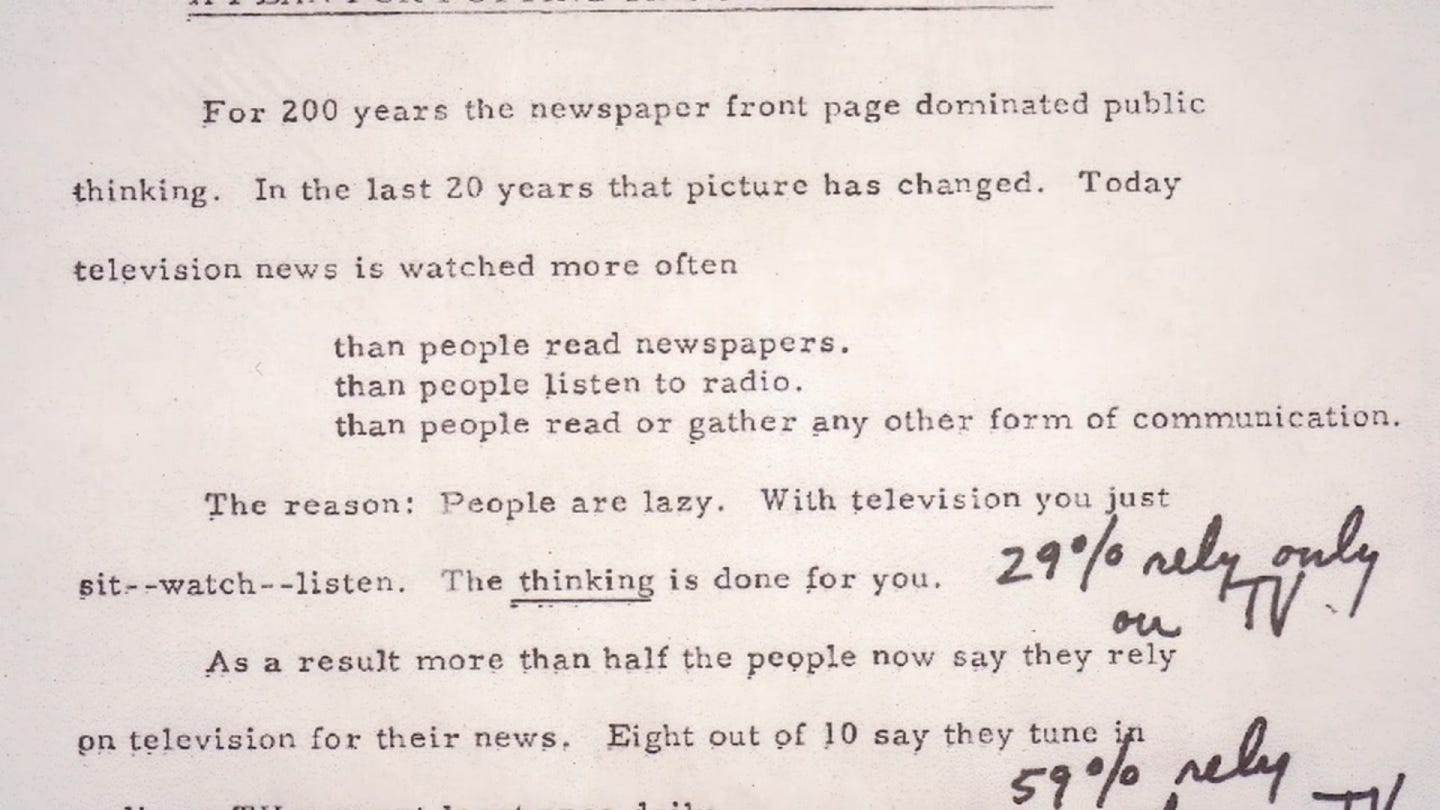
Nixon’s staffer, a young man named Roger Ailes, laid out a communications strategy through the memo you see above. It’s shown in the documentary “The Brainwashing of my Dad.” With television, Ailes said, “you sit—watch—listen” and “the thinking is done for you.” Ailes went on to launch FOX News in 1996.
Perhaps too much video through the tiny screen, like consuming too much gen AI text, is like eating pre-processed food. It’s not good for you.
Put video back in its playpen. To collectively rewaken our imagination and wit. We don’t want to auto-replay Myanmar, do we?